Monday, August 24, 2015

Sermon - The easy hard thing. (Pentecost 13B)..

13th Sunday after Pentecost – Year B                                               August 23, 2015
John6:56-69; Ephesians 6:10-20                                                      Panzer Liturgical Service

Before we started the sermon, I had some of the children pass around baskets of crusty German pretzels... I figured that if we were going to talk about bread one more time, it we might as well have a little snack.

Let’s talk about bread.
Bread holds a special place in most societies. In Germany, it’s the pretzel.. or bretzel… or laugenbretzel as we know it in Baden Wurttemberg. For most people around here, the day is really not complete without it. In Italy, it’s focaccia, in France - the croissant or maybe a baguette, in some places it’s naan or pita, in Mexico it’s the tortilla. In the US – well, we never met a bread we didn’t like.

And it’s not just that bread is a staple in our diet. It goes much deeper than that. Bread gives us comfort and hope for a new day.  It’s been that way for a long time.

When the Israelites were wandering on their circuitous journey to the Promised Land, God instructed them not to take any bread with them – it would be provided on the way. Manna came down from heaven and gave them all the nutrition they needed. They were given exactly what they needed, and if they tried to store some for later in the day, it was spoiled before they could eat it. Through this process, God was teaching them trust – they were dependent on God for what they needed.  And it was a lesson they got, at least for a little while. Until they forgot.

This story about manna reminds us that we are also dependent on God for what we need, even though we often confuse “wants” with “needs”. Most of us live with pantries full of food, taking our next meal for granted. But there are those in the world for whom daily food is not a given, but an answer to prayer… and the faithfulness of those who have enough to share.[i]

This is the fifth week in a row that we have heard from the sixth chapter of John. Five weeks for us to think of Jesus in the context of being bread from heaven. Five weeks – 10% of our lectionary year – and each week, we see the people wrestling with their discomfort of what Jesus is asking them to believe about him.

This week’s gospel lesson actually starts with the last three verses from last week’s lesson.  They are jarring, difficult and puzzling verses… beginning with the idea of eating and drinking the flesh and blood of Jesus, and ending with the promise of eternal life. According to Jewish law, these verses are actually the antithesis of what would bring eternal life. Coming in contact with flesh and blood makes one unclean, with elaborate rituals required to become clean again. For Jews of the day, Jesus’ words are crazy.

And in the grumbling surrounding him, true character is revealed. The ones falling away remind us of what we already know. That following Jesus is easy when it doesn’t require us to change the way we act or think. But when our preconceived ideas about who Jesus is and what he wants from us are challenged, then we grumble and turn away, just like some of his followers did.

Since the third chapter of John, we have watched Jesus do some pretty amazing, even unbelievable, things.  People followed him for miles, enticed by the loaves and fishes. They had been awed by the miracles and fascinated by his understanding of the law and the prophets. But like us, they had their own ideas of what the Messiah should be. They were expecting a big show… just not the kind of show in which Jesus was asking them to participate.[ii]

As time goes on, we see that they often didn’t get the big picture of Jesus’ ministry. They were looking for a different kind of Messiah – we’ve talked about this before. They were expecting a warrior, a ruler, a king. What they got was a homeless peasant/teacher, who spoke of himself in terms that were unthinkable to most. “I am the bread of life” and “I am the living water” paint a much different picture of our Savior.  Jesus’ identity was not then and is not now about fulfilling people’s long-awaited expectations. Jesus isn’t about grabbing power. Instead he identifies himself with the very things that give us life… bread and water… without their sustenance we will surely die. He relates to the least important people around him, and calls them friends.

Like the disciples, we want Jesus to fit a rational formula. We want faith to be easy or comfortable – at least I do. But Peter reminds us, that sooner or later, we have to be willing to have our minds and hearts be changed. We have to come to an understanding that following Jesus is hard, but in faith we realize there’s nowhere else for us to go. Following Jesus and growing our faith in him is the only way we’re going to have a piece of this thing he calls “eternal life.” And then it will be the easiest hard thing we’ve ever done.

In our epistle lesson, Paul writes to a church surrounded by those who do not believe in Jesus, his ministry or his church. He reminds them that they do not battle the skeptics or those who would destroy them alone. He redefines their armor, evoking images of battle protection with the foundations of a faithful life – truth, righteousness, prayer, peace, Spirit, scripture – this is where we should be investing our time and our actions. We want there to be simpler answers to the questions we have. But really, only the weapons will truly defeat evil, in whatever forms it presents itself in our lives and in the world. 

And to end the passage, Paul asks for prayer. He believes that we should pray for everything – for the needs of our lives, for those around us, and for all the saints who have fought the same battles we fight. He’s not talking about prayer as a way to get what we want. He’s talking about prayer to face the difficult challenges that a faithful life will present to us. He’s talking about something that gives us the strength and joy to the hard thing well and in the spirit of love.

Paul refers to his own incarceration, which he rightly believes will end his life. But in that, he is reminding them that God is bigger than any of our struggles. God can make good come from the difficult experiences of our lives. God can turn the memory of the darkest day into one filled with hope for a new day.

This was certainly true for the disciples as they regrouped to follow Jesus, and then later abandoned him to face his arrest and execution mostly alone. And still the resurrected Jesus came to them. What good news for us that the resurrection did not depend on the faithfulness of the followers, but on the faithfulness of the God who has and will keep the promises made since the beginning of time.

I have this friend.  She’s an ordinary, middle-class white American woman. She’s a former military spouse, and until just before I met her, the mother of two towheaded preschool boys. One day, she felt God calling her to adopt a child from Africa. After sharing this with her husband, and her friends, and her church, they began the process to bring a child from Ethiopia into their family – simple, right? Except that, with God, nothing is really simple. After all was said and done, they brought three children home – a girl about the same age as their boys, and an older girl and boy.

Now they weren’t just dealing with the differences in race and culture – now they were the parents of pre-teenagers.  My friend kept saying that God’s dream for her family was so much bigger than she ever imagined. But she just kept trusting.

Through all of this joy and struggle, adjustment and turmoil, she realized that God was continuing to call her to a life she never imagined. So with five children between the ages of 5 and 12, she started the process to become an ordained minister in the United Methodist church. Today she works as one of the pastors at a growing church in Metropolitan Washington DC, and in December will graduate from Wesley Theological Seminary with a Masters of Divinity, one step closer to ordination.
She says that most days she is able to understand that her life has taken a totally different direction than she imagined or intended. But on Saturday nights when she is laying out the clothes for church the next day, at least one of her children will ask, “Mom, do you have to go to work tomorrow?” And she wonders if any of us ever fully understand what Jesus is asking us to do.

It’s my guess, that if you met her, you might ask her if the choices she has made over the last ten years have been worth it, or if it as hard or harder than she thought it would be. And here’s what I think her answer would be… it was the easiest hard thing I’ve ever done. But without the prayer and the support and questions of those who are walking this journey with me, it would have never happened.

And when you look back over your life, I hope that you can see the places where the whole armor of God helped you in ways you never imagined – to get back on the journey and once again follow where Jesus has called, even if you thought it was a place you’d never go. I have missed many opportunities to be the best reflection of Christ in the world, but some days I get it. I can see all the places where doing the hard thing – of following Christ in prayer, in faith, and in supplication – was the easiest and only choice I have.

For many of us, life is getting ready to gear up. School is starting, committees and organizations that we are a part of are making a plan and ready to carry it out. Maybe we’ve just moved here, or are getting ready to start something totally new. I pray that in our new routines we will not forget to rely on and sharpen our battle skills.

Remember that pretzel I gave you to eat at the beginning of the sermon? It is my hope that prayer, worship, bible study, Christian conversation and friendship will become like bread for you – giving you strength and comfort and securing the foundation you need to live a faithful life.

And so I send you into the world – to find the easy, hard thing – and do it.  Amen.

Peace, Deb


[i] Kathleen Thomas Paisley, Preaching Helps from Discipleship Ministries, 8/17/15
[ii] David F. Sellery, “Discovering Jesus,” This Week’s Focus, 8/21/15

Sunday, July 19, 2015

Sermon - It begins with grace (Pentecost 8B)

July 19, 2015                            Mark 6:30-34, 53-56 & Ephesians 2:11-22

I’m a big fan of the NBC Nightly News. And since it comes on here when I am already in bed, I start my day by watching the previous night’s news with my morning coffee or tea. Lately, I’ve been thinking about skipping it (the news, not my coffee) altogether, because of the 6-8 stories reported, most of them bring bad news. Stories of violence often lead off – shootings, violence again women and children, terrorism warnings – it’s hard to watch long enough to get to the “feel good” story that comes at the end. Again and again, I find myself asking, “When did compassion become the exception, rather than the rule?”

This week’s lessons, especially the Epistle and the Gospel, speak to this question. The gospel lesson, two travel tales, are bookends to two of Jesus’ most well-known miracles, the feeding of the 5000 and Jesus walking on water to the boat full of frightened disciples.

The each travelogue begins in the same way. Jesus realizes that his reputation is spreading throughout the region, and people are coming from far and wide, not just to see him in person, or to hear him speak, but because they want something from him. They want healing. They want wholeness. They want to be touched by Jesus.

And at certain points, Jesus realizes that they need to just get away – to rest, recover and do a little self-care. It’s a great lesson for all of us, but one that it increasingly difficult to achieve in our “do more with less” work and world. And I bet there will be many sermons preached this morning on how important it is to take care of yourself. And it is. So here me when I say, “Friends, take care of yourselves and your families so that you can better serve the Kingdom of God.”

But I’m not content to stop there. Because in the stories we have before us, Jesus and his disciples never really got the opportunity to totally shut down. In the first story, the disciples have just returned from their mission trip in Jesus’ name. They were sent out to spread the good news of the Kingdom of God, and to heal sickness and cast out demons. In addition, they have just received the news of the death of John, Jesus’ cousin and the one who initiated Jesus’ ministry with baptism in the Jordan River. This was devastating news and between the two events, it is no wonder that they would want to take some time out and regroup.

But when they got to the deserted place on the other side of the lake, it wasn’t really deserted after all. The crowd had figured out where they were going and beat them there. And in his compassion, Jesus spoke to them, teaching them about the God’s kingdom. As the time grew late, the disciples encouraged Jesus to send the people home to find themselves something to eat. Instead, Jesus took a young boy’s offering, five loaves of bread and two fish, and fed the multitude, with over 12 baskets of scraps left over.

Afterward, they tried again to get away, this time to Bethsaida, for a little R&R – rest and recovery. Jesus sent the boat ahead while he went to the mountain to pray. When he was done, he saw that the disciples straining against a strong storm that had pop up on the lake. So he walked out to them, which apparently frightened them beyond belief. Imagine their further surprise when the storm called immediately upon his getting in the boat. What a confusing turn of events.

In the end, they landed in a different place than for which they set out - Gennesaret, rather than Bethsaida - where again the people pressed in to see and touch Jesus. Everywhere they went, people came bringing their sick friends and relations, all in hopes that Jesus could do for them when he had done for others – bring wholeness in compassion and love.

Paul also addresses this need for compassion and love – not in the realm of physical healing, but in the mending of relationships between Jewish and Gentile Christians. He reminds the church in Ephesus, which had a lot of Gentile Christians, that their relationships are not defined by their differences, but by the One who unites them, in love. From Eugene Peterson’s The Message:
The Messiah has made things up between us so that we’re now together on this, both non-Jewish outsiders and Jewish insiders. He tore down the wall we used to keep each other at a distance. He repealed the law code that had become so clogged with fine print and footnotes that it hindered more than it helped. Then he started over. Instead of continuing with two groups of people separated by centuries of animosity and suspicion, he created a new kind of human being, a fresh start for everybody. (Ephesians 2:14-15 The Message)
That’s the world I want to live in. A world where the differences between us do not define how our relationships will be lived out. Race, gender, sexuality, nationality, religious orientation, politics... these are the arbitrary boundaries that help us find people with whom we are comfortable... people who are more like us than they are not… people who don't frighten us or make us feel good about ourselves.  And we struggle daily, not just to open our hands and hearts to others who are different from us, but to see that they even need to be opened in the first place.  

The reading from Ephesians speaks of reconciliation with and access to God bought at a great price.  We are all strangers and aliens to God, at the same time that we are citizens and members of the household of God. Jesus’ wanderings among people of great need, often dragging his clueless disciples along, should teach us that we are called to live a life of availability, often going against the flow of public opinion and knowing that Christ calls us to live lives worthy of the sacrifice made on our behalf.
I’ve read a lot of really good commentaries and sermons in preparation for this week’s sermon, and usually I pepper my sermon with quotes from the biblical scholars and preachers I follow most closely. But this week I’m going to tell three short stories of compassion, forgiveness and becoming one that make me think that it’s truly possible for us to become the people that Christ called us to be.

Nine years ago, the world stood still as word came of a shooting at an Amish schoolhouse in Nickel Mines, PA. A distraught father and husband entered that one-room school and shot 10 school-aged girls. Five died. Five were severely wounded. That could have been the end of good relationships between the Amish and their English neighbors. But it wasn’t. Lead by their intense Christian training, the Amish modeled what it meant to be part of the family of God.

Within hours of the shooting, they visited the family of the shooter, offering their condolences on the death of their husband, father, & son. They attended the gunman’s funeral, provided food for the family, and offered sincere words of forgiveness. They received the gifts that were offered from the community and the world – gifts of millions of dollars – not because they believed they needed or deserved them, but because they did not want to take away someone else’s need to be generous and make a difference. And they made sure that the gunman’s family had access to these funds, because they believed it wasn’t fair that they benefit any more that the other family because everyone was equally a victim of violence.[i]

And the world asked, “How do they do it?”

A month ago when I was in South Carolina, a breaking news report came across the TV screen. There had been a shooting at a historic black church in Charleston – Mother Emmanuel AME Church – and nine people were reported dead, including the pastor who was also a state senator. I admit that as I went to bed that night I wondered if we would wake to more reports of violence between blacks and whites as we had seen in Ferguson, Chicago, New York and Baltimore. But instead I woke to see a peaceful arrest of the presumed shooter, his return to Charleston that day, and a press conference by family members stating that they had already forgiven the shooter of his deadly deed. I could quote many of them here, but their ultimate message was this – if you intended to start a race war here, you have come to the wrong place and the wrong people. We will only answer with love.

And the world asked, “How do they do it?”

Within weeks the Nickel Mines shooting, the Amish and English communities worked together to tear down the old schoolhouse and built a new one closeby. Four days after the shooting at Mother Emmanuel, a line of people packed the Arthur Ravenel Jr. Bridge, stretching more than two miles from the town of Mount Pleasant to the city of Charleston. Observers on the bridge, and thousands more at the base, joined hands to create a "unity chain," then held a moment of silence that lasted five minutes in honor of the fallen.[ii]

We need to pay attention to this question “How do they do it?” The Amish responded to that question with this answer, “Refusing to forgive is not an option – it’s just a normal part of our living.”[iii] For them, forgiveness lives at the foundation of what it means to be a Christian. It is the bedrock on which community grows.

In South Carolina, the shooting sparked a larger conversation about race and community. It accomplished something that religious and community leaders had been working toward for decades. Yes, there has been some backlash from the events of the last month – at least 3 SC black churches and 5 others in surrounding states have been burned to the ground, but it looks like love will prevail, even outside the Christian community.

Muslim friends through a crowdsourced fundraising site have raised $92,000 in just 10 days to help rebuild black churches as a part of their Ramadan observance, stating
We want for others what we want for ourselves: the right to worship without intimidation, the right to safety, and the right to property. We must always keep in mind that the Muslim community and the black community are not different communities. We are profoundly integrated in many ways, in our overlapping identities and in our relationship to this great and complicated country. We are connected to Black churches through our extended families, our friends and teachers, and our intertwined histories and convergent present. Too often cowards inflict us with a crippling fear, but with encouragement and support from likely and unlikely places fear cannot stop us.[iv]
I think that’s exactly what Paul was talking about. And still we ask, “But how can I step outside my comfort zone and do something like that?”

Two weeks ago, our teen-aged nieces came to spend 12 days with us. We toured together and cooked together and swam together and just enjoyed being together. And just when I thought that they would get tired of hanging out with their boring old aunt and uncle, there was a knock on the door. Our neighbor’s 14-year old daughter came to ask them to walk to the park with her and a friend. And we let them, worrying all the time if we had done the right thing. And as teenagers will, they exchanged What’s App and Facebook information, and messaged each other throughout the week. On Friday night they went together to the town pool party, and said fond goodbyes as the girls prepared to leave last week.

And when I thanked Selina for including them in her activities, she responded by saying, “I just thought about what I would like someone to do for me, and I did it.”
And if that’s not the gospel in a nutshell, I don’t know what it is. So here’s my charge to you: Let’s act as if we believe Paul’s words - “for we are no longer strangers and aliens, but are members together of the household of God” (Ephesians 2:19 NRSV). 

And love will come. It all begins with grace. Amen.

Sunday, June 14, 2015

Sermon - One for all (Pentecost 3B)

Pentecost 3B                                                                                                                      June 14, 2015
Mark 4:26-34, 2 Corinthians 5:6-17                              Panzer Liturgical and Patch Protestant Services

I do love Spring. I can’t wait for the garden center to put out the containers of flowers and vegetables, to look at packages of seeds, to think of the harvest ahead. We have a big garden plot in our back yard. Last summer we planted some lettuce, and enjoyed it before the frost came . This year we waited with great anticipation for it to be warm enough to plant – May 15th. We purchased some flowers for window boxes and pots in the front, four tomato plants, and seed packets for leaf lettuce, carrots, beets and radishes.

Talk about immediate gratification. It took less than 28 days from planting to harvest to gather a large bowl of radishes – 2 different kinds. And on Saturday, we planted again, so that we could have more in another 28 days.  Our tomato plants have blooms, some small tomatoes are setting, and so far, no black rust fungus. Our lettuce is getting close to ready and the beets and carrots have broken through and look like they are going to make a good showing later this summer.

How does this happen? A seed gets planted in the ground and sooner or later, a crop is ready to be harvested. Oh, we do a little – make sure there is good soil, take away the weeds, give them water and sometimes shelter them from an unexpected cold. But the process of growing is really out of our hands, unless we kill our crop from benign neglect. What a miracle to watch fruits and vegetable and grains come into their full potential all around us. All we have to do is sow and get ready for the harvest.

When you heard the lesson for today, I’ll bet you said, OK, today’s lesson is the one about the mustard seed, I know this one. In fact, the mustard seed is the star of parables in all three synoptic gospels, but is used differently in each.  In Matthew & Luke it’s a simple message – the mustard seed is small, but grows into a big tree. It’s a metaphor for faith – faith, even if it’s small, is big enough to uproot the largest tree.

But in Mark, Jesus prefaces the mustard seed parable with another about sowing seed. It addresses the joint nature of the harvest. The sower plants the seeds, maybe carefully, maybe just throwing them to the wind to fall down where they may. But the biggest process is not in the sower’s control. Botanists can describe in great detail what’s going on under the ground, but it seems like a huge miracle when you plant a seed that’s the size of a grain of sand, and a month later you have something crunchy to eat on a salad. Yes, the sower or farmer can make conditions optimal for growth, but the power for the seed to sprout and make fruit is the hands of God and his creation alone.

We are quick to put all kinds of conditions on what it means to be a person of faith. Did you say the right prayer? Where you baptized by the right person in the right church by the right means? Are you attending the right church? How do you interpret scripture? Do you follow the right rules?

But Jesus seems to contradict this premise. In the first parable we hear that “the kingdom is like scattering seed.”  The sower/farmer doesn’t know exactly how it happens, but the seed grows and the harvest comes. And that makes many of us uncomfortable, right? We want to ask Jesus, are you sure that the kingdom comes in spite of us? Apparently, both Matthew and Luke are uncomfortable with this world as well; they omit this first parable and all talk of secrets. What remains clear in Mark’s view of the kingdom is that it is a marvelous thing and not really under our control. Small beginnings cam make for large outcomes, even when our intentions get in the way.[i] 

Our work in God’s fields matter, but when we are tempted to claim credit for the conversion of souls to Christ or the growth of the Kingdom of God, we must remember that God works whether we are awake or asleep. No matter how committed we are to the process, our efforts are small like mustard seed in relationship to the infinite nature of God’s kingdom, and they are able to be whisked away in the slightest breeze. But God chooses to bless them and grow them, sometimes beyond our wildest imaginations.[ii]

And that’s the easy part of the lesson. But there is a more difficult message imbedded in this second parable… difficult if you like your Kingdom of God neat and orderly and the way it’s always been. If you ask any farmer in the Middle East about the mustard tree or shrub, they will tell you that once it gets in your garden you may never get rid of it. So maybe one of the first questions a person in Jesus’ audience would ask is, “Why would you intentionally plant mustard seeds in your garden?” Not only is it a rather knarly weed, but when it grows large enough for birds to come and roost in its branches, those birds are going to do a lot of damage to the other crops you have planted.

Last year we had to place a net over our small lettuce crop, because the birds kept swooping down and carrying away our harvest. This year we have applied a different tactic, and so far it’s working just fine. All that said, roosting birds in a garden will eat your crop, wake you up early and leave little presents behind … it’s hard to imagine a world where you invite them to come make a home with you.

But that’s exactly what Jesus did. He invited everyone to come and follow him. The passage that we read today from 2 Corinthians is pretty complicated and convoluted, but it ends with a declarative statement. Paul writes:
For the love of Christ urges us on, because we are convinced that one has died for all; therefore all have died… So if anyone is in Christ, there is a new creation: everything old has passed away; see, everything has become new! 2 Corinthians 5:14,17 (NRSV)
Paul said a lot of things that we as the church declare as definitive – absolute must-follows for faith. Well, I think we need to add this one to the list. Here Paul echoes the message of the parable. Jesus came and died for everyone… for you, for me, for the person next door, for the guy who stole your parking place at Wal-Mart, for the people sitting on death row in Texas, for those who haven’t even heard of him yet, for those who don’t believe.  And when people do commit themselves to Jesus, they are a part of our family, whether we want them to be or not.

But do we really believe this? Do we believe that every person who has walked on this earth has value simply because “Christ died for all”? Do we believe that because Jesus was willing to die for everyone, that gives their lives intrinsic value? Even at my most optimistic, I would have to say, No, we don’t. 

Author and pastor Dawn Chesser puts it this way:
In fact, most of us live quite the opposite of this. We want to say, ‘IF you do this, you do that, you live this way, you say these words, you vote this way, you vote that way, THEN you will have value.’ But Paul says that each person’s value has already been established through Christ’s death… We don’t need to know whether or not a person has confessed Christ as his or her personal Lord and Savior before we decide to treat him or her with dignity and respect… We don’t need to know anything about the person, because we already know all we need to know: he or she is valuable because Christ died FOR him or her, just as for us.[iii]
It’s easy to get caught up in a “them vs us” mentality. In our worlds of education, position , income and status, we forget that “the original followers of Jesus were, in the eyes of the culture, all pretty much losers – lowly fishermen, despised tax collectors, prostitutes and criminals, lowlifes loathed by the religious establishment. [But ]maybe that’s the way the followers of Jesus have always looked to the rest of the world – those people desperate enough, lowly enough, to find hope in Jesus’ message.”[iv]

But this where we find hope: When we are struggling, experience significant loss, or just can’t seem to find our footing… when we wonder what the future holds and if this Jesus life is really for us, Jesus reminds us that the Kingdom of God comes of its own…and it comes for us. There is room for everyone in this kingdom. Jesus’ parables tell us that all things are possible because our God is great. We are those rascally birds who come to the giant weed-shrub for shelter, making noise and leaving a trail behind us. We think the work of faith is difficult, but really all we have to do is recognize our own need, and the needs of others to be a part of a community where everything is possible through the love and power of God.

I served a church in Oklahoma in a small, rural community it the middle of a high plains desert. It was hot and flat with lots of wide open spaces, which is pretty good if you want to teach new pilots how to fly big planes. The people there were either farmers and ranchers, worked at the Air Force base or at the local meat processing plant, or supported those industries with stores and restaurants, schools and churches. 

In this town, there is a right and a wrong side of the tracks. And it would be easy to keep those distinctions, especially in church. But when kids at the local elementary school told their parents that some classmates didn’t eat from school lunch on Friday to breakfast on Monday, a backpack ministry was born, sending home non-perishable foods to tide students over for the weekend. When teenagers from the youth group encountered folks asking for money for food when they were having a camp fundraiser, a monthly free meal was started, and soon spread to other churches so that every Saturday there was somewhere to get a hot meal at lunchtime, no strings attached.

When the local Christmas toy drive was short on the number of gifts needed for the children registered, $10,000 was raised in two days, with individuals and businesses pitching in to help. Last year, Project Noel provided gifts for 700 children and youth in that community.  This year, their vacation bible school invited children from every neighborhood to participate and dozens of adults and youth helped them get excited about Jesus.  Each week, a bus or van goes to each neighborhood and picks up whoever wants to come to church – children and adults alike. It’s no wonder that people refer to this church as “the one that helps people.”

Perhaps the next hardest part of our Christian journey is not how we come to faith ourselves, or even how willing we are to spread the good news around us, but how we respond to those who believe and are willing to come to Christ. The Christian church, especially in the United States and Europe, seems preoccupied with the numbers related to church membership and blind to the way that faith is being lived out in the world. Maybe it’s not enough to focus on the macro - like asking about how many people are coming to worship on Sunday morning.

Instead, we need to understand God's measure of growth: love. And in the process, we are compelled to ask ourselves these questions: Are we totally committed to loving God and neighbor? Do we make our every encounter an opportunity to witness his love? Are we guided by his word? Do we live in an ongoing dialog of prayer... speaking and listening to the divine presence in our lives?[v]

Today’s readings inspire us to see God in unexpected people and places. We are called to look beyond the obvious to discover God everywhere, in everyone. And while the life unfolding around us often feels precarious and unimportant – and our role infinitesimal – a great harvest and great possibilities are on the horizon for those who see from a God’s eye view, through the eyes of faith. Great things do come from small beginnings.[vi]

Amen.

Thursday, June 11, 2015

Spain vacation - random thoughts - June 2015

We just got home from our big vacation of the year... the Andalusia region of Spain was quite amazing and I'm sure we only scratched the surface. Here's the rundown in a nutshell:

Days in Spain: 12
Kilometers in car: 1418 (850 miles)
Deb's Fitbit Steps: 152440
Which is equal to 62.2 miles
And flights of stairs 214 - most of them in Granada

We basically spent time in 5 regions - the beach from Rota to Los Canos de Meca, the African city of Tangier, Morocco, the rock known as Gibraltar, the historic city of Grenada, and the bustling metropolis of Seville.  Along the way, we took almost 1800 pictures and documented the beautiful countryside, architecture, art and food of the region.

As we went along, there were these mottoes which kept going through my brain. They highlight some of the struggles and surprises we encountered along the way.

In Rota: We're open unless we're not - time is relative
In Granada: What comes down must go up - very, very hilly
In Seville: There's a reason why we close in the middle of the day - Hot, hot, hot!
Seville Cathedral: More is more - gives new meaning to the phrase, "over the top"
Me: You can never have enough sunscreen or sangria or a soft enough bed.
5 College students from Texas Tech: We want pancakes so bad, we're willing to walk a mile in this heat to get them.
Tim (Shawn's dad): Is it time for ice cream yet?
Shawn: Wow, these old towns have narrow streets!


We had the great fortune to be in Spain for the Feast of Corpus Christi, 10 days after Pentecost. We were able to see the crowds gathered for worship and for the processional that morning in Granada. We visited beautiful churches that were not only filled with tourists, but also with worship - services for weddings and baptisms and the Eucharist. We decided that faith may be on the decline in some places but not in Spain - church is an integral part of people's lives and in the life of the society.


We walked on the beach, enjoyed the sunshine, and ate outside - a lot.  We had seafood almost every day, and ate a lot of really good ham. We never got good at eating really late, going to restaurants when they opened at 8pm and often the first customers there. We went out in the morning, rested in the afternoon and went out again after 6pm when the sun started going down and the temperatures started dropping.

Surprises along the way:
* A really great hamburger in Seville at "The Good Burger" - like "Five Guys" good.
* You get used to taking the heads off of your own shrimp... really.
* In Spanish tapas bars, tables are for eating and the bar is for drinking, and if you sit at a table you won't get your free tapas, but your feet won't hurt so badly.
* Cathedrals come in all shapes and sizes - baroque, Romanesque, gothic... some filled with light and some dark and mysterious.
* If you're looking for great classical Spanish art, don't go to the museums, go to the churches - that's where the great paintings and sculptures live.
* Eventually, you're going to want a pizza.
* The majority of my pictures are of architecture, tiles, ceilings, windows, doors, floors and food - the sights were mesmerizing.
* Our guide in Morocco said a very wise thing when he was talking about how people of different religions have found peace together there... he said, "I am Muslim and I don't understand everything about your religion and you are Christian and you don't understand everything about my religion, but that shouldn't keep us from being friends." I couldn't help but agree.

Peace, Deb


Sunday, May 24, 2015

Sermon - Go Be The Church! - Pentecost Year B

Acts 2:1-21                              Romans 8:22-27                            John 15:26-27; 16:4b-15

It’s been 50 days since Jesus’ crucifixion and resurrection… 50 days filled with doubt and wonder and the bare beginnings of our mother church. But even when Jesus was among them again, teaching them and breaking bread with them, the disciples were still trying to figure it all out. They were still missing a piece of the puzzle. They were still trying to understand what it would be that would hold them all together, and give them their new, true identity.

Do you remember the story of the Tower of Babel in Genesis 9? That story begins with a united people, with a common language and purpose, but ends with many languages and confusion, and the scattering of people who were no longer “a people”. But the day of Pentecost is the natural solution to those many generations of people looking out for themselves. At Pentecost, the story begins with many languages and ends with many languages, but in the middle of the story, something amazing happens. Tongues of fire rested on each of the disciples, and God gave them the ability to speak and understand in languages that were not their own. And if that were not enough, the crowd of strangers that gathered understood the message of God in their own languages, to the amazement of all. The message of the day was simple: the power of God will make you one if you will call upon the name of the Lord.[i]

It’s a powerful and amazing story – and frightening at the same time. What would we do if something like that happened here? I imagine that we would follow proper military protocol, usher everyone out in an orderly manner, reassemble at a safe distance away from the building, and wait for the fire trucks to arrive. But the disciples didn’t seem so much afraid as they were amazed. And Peter was ready to speak a word of truth to the crowd that gathered.

This gathering of disciples happened only ten days after the ascension of Jesus. I am sure they were still basking in the glow of his presence and planning what their next steps would be. The coming of the Holy Spirit, as promised by Jesus, was not just a spirit of counsel or peace.  It came as fire and wind, two of the most powerful forces on earth. The events of this day provided an important example, where Jesus said to the church, “Don’t do this without me.”

I think that Pentecost gives us some important reminders of what it means to be the church. First, we are called to be one. We are called to gather in his name and proclaim the message that Peter proclaimed – that “…everyone who calls on the name of the Lord shall be saved.” Over the last 2000 years of Christianity, we have seized every opportunity to break apart over differences in the way we think about and practice ministry in Jesus’ name. In our confirmation class at Patch, we spent a whole lesson looking at the history of the church and seeing how the same controversies keep repeating themselves, over and over. We forget that the Holy Spirit’s first gift was to make us one… by helping us speak and listen in a common language – the language of love.[ii]

In today’s church climate, it seems that people are looking for an excuse to break apart. Many church traditions are struggling with how to apply scripture to their own lives and in the world. The Great Schism happened in 1054 and describes the split between the church in Rome and the church in Constantinople, giving us Orthodoxy and Catholicism. And ever since, more people have splintered off – often for good reasons, but our oneness is less and less evident as the years go by.

But what would happen if we didn’t think so much about what makes us different, and instead about what makes us the same? What if we regularly crossed denominational and racial boundaries and showed the world a glimpse of that first Pentecost Sunday? Would that help our churches grow? Would that turn people toward Christ, rather than away? When non-Christians are asked to use one or two words to describe Christians, they often come up with “hypocrite” or “two-faced” or “closed-minded.” But today’s celebrations remind us that Jesus and this day of Pentecost are our salvation from who they think we are.

Jesus rescues us from the law… being a Christian isn’t about following a prescribed set of rules, but is about living a life of love in response to what Jesus did for us. But we forget that, over and over again. We fall back into familiar patterns. We forget that we are free, and creep back to the shelter of old ways. And we tell people if they want to join us, they have to follow our rules, our interpretations of Jesus’ teachings. But that’s not what Jesus wanted for us.[iii]  Today reminds us that the Spirit makes us one.

Second, we are called to tell the story. Sometimes, the only part of Jesus’ story others will hear is the story you live. I think a lot about whether my words about Jesus and my actions tell the same story. Sure, it’s important to know the story, how to talk about who Jesus is and why he came and who he is calling us to be. But if Jesus only occupies an hour or a day of our week, then we have really missed the point of Jesus coming at all. And if the way we talk about Jesus and the way we live for Jesus are not rooted in love for God and for one another, then we are really missing the point.

When we are confronted with stress and discord in our relationships with others, our base instinct is to flee to a safe corner and remind ourselves our why we are right and they are wrong. The more difficult task for healthy and growing relationships is to stay and work through differences, sometimes coming to a satisfactory compromise, but at least understanding a little more about another person or group’s perspective. Nothing about that process is easy, nor is it painless. But it is the way that the early church stayed united for as long as they did. And it is how the church grew so quickly in the beginning, because people out there were saying, “I want you have. Introduce me to Jesus.”

Third, we are called to trust the Spirit. In Jesus’ last discourse, he told the disciples, “But when the Friend comes, the Spirit of the Truth, he will take you by the hand and guide you into all the truth there is. He won't draw attention to himself, but will make sense out of what is about to happen and, indeed, out of all that I have done and said.” (The Message) Other translations use Companion or Advocate or Paraclete, but in every case, this is the description of one who stands beside us, no matter what. The Spirit will show the world, as was witnessed at Pentecost, that Jesus has not abandoned us.[iv]

Now, trusting the Spirit does not mean that nothing bad will ever happen to us, or that prayer or tithing or acts of faith will magically solve all of our problems. Many of the early followers of Jesus suffered tremendous hardships, some even to death. And ever since, when dedicated Christians have chosen to follow Jesus, their lives have not always gone according to plan. But they did it because they knew something special – as Paul wrote to the church in Rome, “… the Spirit helps us in our weakness (Romans 8:22).

Let’s face, there’s a lot about the world that doesn’t make sense. The enmity between religions, especially between Christians and Muslims, the destruction of holy sights of many religions, the persecution of people of faith and people of different races, the effects of climate change, the political climate in many countries… we have a lot of the be concerned and even afraid of these days. 

But our fears are not that much different than the fears of those first Christians. And they spiritually overcame the obstacles before them. Let’s be clear: they were not considered powerful by the standards of the world. But the influence of the church spread like wildfire through the Mediterranean world. Paul’s missionary journeys and the Christians he left behind in each place grew a Church that could not be contained by the governments of the day.

Eventually, the Church became one of the most powerful institutions in the world. And looking to the near and distant past, we can see that as a player in the power game, the message of unity and love can get distorted. Some days I wonder if our allegiance to our denominations or theological persuasions gets in the way of living out the gospel in the most authentic ways. Turn on the television, read the paper, look at Facebook or other social media and you will probably see more messages of shaming than messages of love. Is that really what the gospel is about?

In his book, Crazy Love, Francis Chan begins with this quote from 17th century French priest Francois Fenelon, “To just read the Bible, attend church, and avoid “big” sins – is this passionate, wholehearted love for God?”[v]  And yet that’s the way many of us live.  But what would it be like if we really got to know God in all of his infinitely amazing ways?   What if we took Jesus seriously and committed to loving others wholeheartedly?  What if the Bible and its story weaving through time became our story?  What if we acted like we ARE the holy catholic church that we profess in the Apostle’s Creed? What would life look like then? 

The church at Pentecost knew something that we can also know. They experienced the love of Christ and through their interactions with him they were convinced that Jesus was God in the flesh. And that love could not be stopped once it gained a foothold.  It melted barriers of fear, guilt and self-centered-ness, and poured through them like a raging stream. It changed the kind of love they felt for each other and for strangers. And a new definition of love was born – agape love – that transcended all definitions of love that they had ever known. This love embraced sinners and outcasts, Samaritans and enemies. It gave, not in order to receive, but because giving was its nature.[vi]

Every minister has a favorite illustration, and I’m closing with my favorite one today. Tony Campolo, American Baptist minister and professor at Eastern College in PA was in Hawaii preparing for a speaking engagement, and on the first night there he couldn’t sleep, so he went to an all-night diner.  About 3am a group of eight women came in, laughing and talking loudly.  Overhearing their friendly conversation, he learned that the women were professional escorts, finished with their night’s work and relaxing before going home.  He also learned that one of the women would be celebrating her 39th birthday the next day. 

After the group left, Campolo got an idea.  He talked the diner owner and his wife into helping throw a birthday party for her the next night.  24 hours later the diner was decorated with streamers and balloons.  Customers who heard about what was happening stayed around to help with the surprise.  As the ladies entered the building, everyone inside shouted, “Happy Birthday, Agnes!”  Agnes was in shock.  People laughed together and hugged her, and after being reminded to cut the cake, she begged them to let her keep the cake as a reminder of the wonderful day.  “I’ve never had a birthday cake before – please let me take it home to show my kids.”

As surprised as they all were, they couldn’t think of a good reason to refuse her request, and so she left with the cake intact, as if it was the best gift ever.

Tony broke the awkward silence in the room by saying, “Why don’t we pray?” and without hesitation prayed for Agnes in her life, asking God to bless her on her birthday, bring peace into her life, and save her from all that troubled her. After the “Amen,” the owner said, “You didn’t tell me you were a preacher.  What kind of church do you preach at?”  Tony thought for a minute and said, “Well, I preach at the kind of church that throws birthday parties for prostitutes at three o’clock in the morning.”  To which the owner replied, “No, you don’t.  There is no church like that.  But if there was, I would join a church like that. Yes, I would definitely join a church like that.”[vii]

Through Jesus Christ, God calls us to be one. When we eat and drink at the table, when we turn to God, when we believe and seek him in prayer, in church, and in the world around us, he comes. He awakens in us gifts for service to one another and the world. And he has begun a new work in us, and through us, so that his kingdom may be as alive in us as it is in heaven.

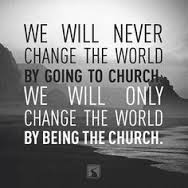
So let’s go be the church. Amen.

Peace, Deb
May 24, 2015   Panzer Liturgical Service, USAG Stuttgart


[iv] Pulpit Fiction podcast, Pentecost B, Robb McCoy and Eric Fistler, May 25, 2015
[v] Chan, Francis, Crazy Love, p 21.
[vi] Smith, Houston, The Christian Century, (October 4, 2005, p. 10f)
[vii] Campolo, Tony, The Kingdom of God is a Party, Word Publishing, 1990, pages 3-9.