Friday, May 11, 2018

Workshop: How to Give a Devotion or Testimony in 5 minutes or less

In February 2018, I gave a workshop for the Stuttgart PWOC on how to give a devotion. People were sharing good things, but often they were too long, or it was too hard to get someone to say yes. So when asked, I said yes, and put together this presentation, which took up about 40 minutes, including "question and answer" time. I have amplified my notes and slides to recreate what we experienced that day. I hope you find it helpful. 
=========================================================
A couple of years ago, I went home to visit my parents and my dad asked me to make him a good German supper. “What’s your pleasure?” I asked. “Bratwurst, sauerkraut, and potato salad,” he replied. “I can do that,” I replied and off I went to gather the required ingredients. I went to a local German deli and picked up some homemade sausages, dug into the cabinet for a can of sauerkraut I had sent for Christmas, and boiled up some new potatoes to make the recipe taught to me by my German neighbor. When I put the dishes on the table, my dad looked at the bowl of potato salad and asked, “What’s that?” “German potato salad,” I replied. “That’s not potato salad! Where’s the mayonnaise and eggs and bacon?”” He said. “Well, don’t tell my friend, Sandra, who spent a lot of time making sure I got this just right.” When we finished eating, I asked him how it was. His reply – “It was good, just not what I was expecting.”

All of this is to say that the content of this workshop is mine alone, curated over the last 35 years of giving devotions, testimonies and sermons, warts and all. It may not be what you're expecting, but I hope you enjoy it just the same.

PWOC (Protestant Women of the Chapel) offers women in the military community a place to grow in faith in Jesus Christ and in faith with one another. Bible study is a large part of that journey. Program days and retreats are also an important party of our PWOC experience and we are very thankful for those who plan for these occasional opportunities for learning and fellowship. Outside of those events and our weekly bible studies, our morning fellowship devotions are a very personal way that the gospel message gets transmitted among us. We are always happy for those who are willing to share. 

Think about these questions:
How many of you have been asked to give a devotion at PWOC or some other event? How many of you have said yes? 
What convinced you to say yes? What keeps you from agreeing to take on this challenge? 

Please don't feel alone if you don't know how to start planning to give a devotion… I often feel that way. Also, don't feel bad if you did it and felt like it went off the rails somewhere along the way. It happens to all of us, even those of us who have done it for a long time. 

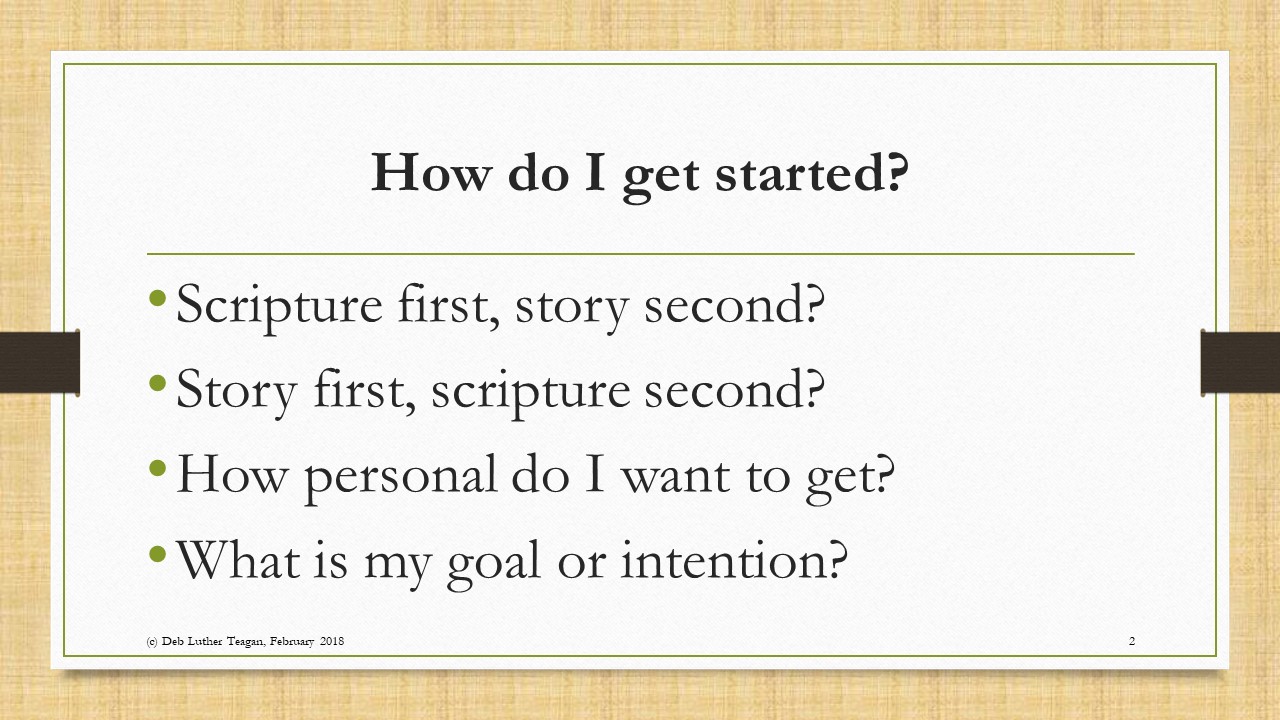
I’m willing to guess that these are the questions that you all have when beginning the process of preparing a devotion: Do I pick my scripture first and then share a personal experience to go with it? Or do I think of something I want to share about my life and then choose a scripture to fit the story? That is usually where most people start. But I'm going to ask you think about this process in a new way. And that will begin with some definitions – my definitions of devotion, testimony, and sermon.

A Devotion is a story that describes an experience of the presence of God or gives a model of discipleship or faith journeys. The key goal is Inspiration. In a devotion, we are often asking people to see how God is experienced in the world.

A Testimony is a story that tells of your personal experience of God, with the additional purpose of converting marginal Christians or unbelievers and encouraging those who already believe. 

Lastly, a Sermon is a manner of examining scripture to impart biblical knowledge and/or inform Christian Discipleship. It is usually given in a worship setting, complete with scripture readings, hymns and other elements. This is a much more intricate and in-depth process and not the expected length or scope for a devotion or testimony. 

Here are some things to remember as you prepare for to give a devotion or testimony.
We have very short attention spans – usually about 5 minutes unless we are prepared to concentrate longer. One typewritten page is usually more than 5 minutes
Devotion time is like a warm up to the day – opening ourselves to the Holy Spirit as we prepare for class and the community that we share there.
Preparing for something short is harder than preparing something long

Think about stories you’ve heard or seen, something you’ve read, someone you know and tell the part of the story that inspires you.
Think about the scriptures you know best - Stories Jesus told, stories about Jesus or lessons from characters in the bible.

The best devotions come when we pay attention to what’s going on around us and see God present in all the experiences of our lives, not just the overtly religious ones
It helps to think of your faith story in snapshots or video clips
Ask yourself these questions: How do I see God working in my life? What changes did or will I make because of this encounter with God? How am I encourage to stay the course and keep the faith?

Choose scriptures wisely - Make sure they mean what you think they mean. It’s better to choose a few scriptures that you study well, instead of making a scripture fit inappropriately. 
Stay away from platitudes. They often do more harm than good.

AND It is also perfectly acceptable to read a prepared devotion that was meaningful to you if you prefer not to share something that you write yourself.

I’ve been doing this a long time, so I’m pretty accomplished at the 5-minute devotion, which some people in my family call, “the blessing.” I like to think it’s not because I’m super holy, because I am not! But I do try to be intentional about seeing God and Jesus and examples of the Kingdom of God in the things I read, the shows and movies I watch and the places I go. 

Here's an example of a devotion, using the criteria previously discussed:
Nathan Chen, Olympic skater, had a disappointing short program in the 2018 Winter Olympic games. He was the favorite of many commentators, and when he fell in the short program, lots of people were heard saying that he didn't live up to his hype as the most balanced male skater for both athleticism and elegance. His preliminary skate was so flawed that he barely made the finals of the men’s competition, which placed him at a significant disadvantage in the finals, making him one of the first skaters of the night. And in that brief 5 minutes, he skated one of the most beautiful programs eve, landing 6 quadruple jumps, a new Olympic record, and the 3rd highest score for a long program in competition history. Her finished 5th overall, but in the end he said that he had to go out there and give it everything he had, for his teammate and the love of skating, and because that's everything he had been training for.
And as i was watching this story unfold, i got this glimpse of how this is like a life of faith. We want to live perfectly, but we make so many mistakes along the way. Instead of giving up, we are called to get back up and start fresh every day. In Paul's letter to the Hebrews, he wrote:
So then let’s also run the race that is laid out in front of us, since we have such a great cloud of witnesses surrounding us. Let’s throw off any extra baggage, get rid of the sin that trips us up, and fix our eyes on Jesus, faith’s pioneer and perfecter. He endured the cross, ignoring the shame, for the sake of the joy that was laid out in front of him, and sat down at the right side of God’s throne. Hebrews 12:1-2 CEB
So, if you fall, get up. And give it all you’ve got. There is joy ahead of you, if you will only keep running toward it. Amen.
Discussion: I often see the God-life in the things I see on TV or in the movies. I don’t think that something has to be explicitly religious or Christian to have great spiritual value. This kind of discernment comes with practice. Religious people are quick to say that the media industry has worked hard to keep religion out of what we see and hear. But I don’t find that to be true. Some of my favorite books/movies/plays with strong religious themes are Wonder, Les Misérables and The Greatest Showman, recently released on DVD. I could do a whole season of devotions from just those three works. God, faith and discipleship literally drip from the words on the page and the songs. If you begin to look, I think you’ll be surprised at the places where God shows up, even when you least expect it. These insights are a great way to remind people of how God is all around.

Here is an example of my testimony (I have many different permutations of this, filed by decade!):
I’ve been a Christian my whole life – I don’t remember a time not knowing who Jesus is and why I need him in my life. And I was raised as a High-Church United Methodist, so the idea of preparing a testimony was really foreign to me until I got to college, where I met a lot of people who asked me the question, “Are you saved?”, which was also a new concept. At first that question really turned me off, but gradually I came to appreciate the opportunity to share how I met Jesus at every step along the way. There were lots of times when I didn’t think I needed God, or that he had taken a break from me. But eventually I realized that he doesn’t do that, ever, and preparing multiple short testimonies has helped me break my crazy, complicated story into manageable pieces. 
The story of my call to ministry is interesting to me and travels a very winding road. But now in my late 50’s I realize that I’d rather talk about the ways that God is still working through me. And as I prepared for PCS season 11 times and my husband’s retirement from the AF last year, I realized that my signature story is in the parable of the Sower (Mark 4:3-9) 
I went into the ministry confident that I would pastor churches in SC and follow a traditional model, like most of my friends. But 11 PCS’s, pastoring 4 congregations in 4 different states, and volunteering in 3 chapels and 5 local churches later, I realize that while I may not see the harvest in most of the places I serve, my call is to be a faithful sower, sharing the good news about Jesus, and modeling a life a faith wherever I go. 
When I was in SC recently, I went to a retreat planned and executed by a woman who was a 7th grader in my first pastorate. As a 7th grader, she did this cool thing at a worship service… she interpreted 1 Cor 13 in personal language, saying, “When I a child, I did childish things, but now I am a woman” … I knew that she got it. And it was something that has bound us together for over 25 years. As the weekend retreat was winding down, I realized that her vision had touched 50 people in a way they would never forget. And as we closed, she gave kudos to her team and then said, but none of this would have been possible without Pastor Deb, who keeps telling me that God will use me if I will just let him. Humbled and blubbering, I realized that while I don’t really remember saying that to her, the ways that I talked and preached and lived over the years made an impression that lasted and inspired, long after I was gone. 
My prayer every day is this: Lord, give me the courage to live faithfully every day, sowing the seeds of your love and grace in all that I say and all that I do.  Amen
Discussion: I find that one of the ways that I am prepared to share devotions and testimonies is that I write them down. For instance, I know that a 5-minute devotion will take up one, single-spaced, typed page. To begin, I write topics in a journal, then fill those pages with quotations, memories and scriptures. Eventually, they will make their way into to a devotion, testimony, or sermon. For me, the process of producing this kind of utterance often starts long before I am even asked to speak. It has become a part of my spiritual discipline and serves me well along the way. 

There is much to learn and much to share. I encourage you to begin the journey of preparing in advance for a word of faith and hope. I promise it will be time well spent.

Peace, Deb

© Deb Luther Teagan, Feb 2018, Stuttgart, Germany


Sunday, May 6, 2018

Sermon: Love for God = Love for All

Easter 6B                                                  Panzer Liturgical Service, Stuttgart, Germany
Acts 10:34–48, 1 John 5:1–8, John 15:9–17                                                May 6, 2018

We live in The Between Times – the times between Jesus initial ministry and his coming again in glory. We use the lessons that he taught to prepare to be ready for his return. In the early Church, Christians believed that they would live to see that day, so the early New Testament writings are filled with encouragement and warnings to hold on just a little bit longer… Jesus was coming back soon! But Jesus didn’t come back soon. Almost 2000 years have passed since his death and resurrection… 2000 years of individuals and organized groups of Christians trying to figure out how to keep his teachings alive, relevant and faithfully lived.

And in those 2000 years, a lot has changed. Christian Theology – the study of God, Jesus and the living of faith – has evolved, and in that time, we have gone from being a universal Church with a single focus of caring for one another to multiple denominations, too numerous to even count. In the military chapel community, we specialize in downplaying our denominational affiliations, if we even have them.  Especially overseas, we realize that our unity comes not in emphasizing our differences, but in celebrating our common ground.

For many, church is just a place, not a way of life. But a life of faith is more than just a Sunday’s work. A life of faith is a life of discipleship, of daily making the choice to follow Christ and to serve him and the world in all we do.

Jesus spent his ministry teaching important lessons. Following Jesus wasn’t about memorizing scripture or learning the progression of theological thought. Life with Christ was imitating the actions of Christ. It meant welcoming people that others rejected. It meant learning to see good in what the world judged as bad. It meant being willing to put the needs of others ahead of your own needs, even if in meant leaving your own life behind.

When I read the passages for today, I realized there were some things I especially wanted to make sure we all realize.

*WE ARE CHOSEN
In school, it’s natural to pick sides. We tend to hang out with people who are like us, who share our interests, people we like spending time with. But it’s easy for the groups that we hang out with to become exclusive, and for us to cut off others in order to keep feeling like the friendships we have are special. Eventually, we can think about friendship in terms of how it makes us feel, not how it influences the way we behave.

Jesus taught us something different about friendship. Jesus chose people to be with him from all different walks of life. He didn’t expect them to biblical scholars or teachers. He invited everyone who heard him teach to just follow him. He asked them to watch the way he honored God and treated others and to do the same themselves. In today’s lesson from John 15, we hear Jesus telling his disciples and others gathered the days before his death that friendship with him is one of the most important gifts ever given. This friendship is defined by more than just feeling good about being a part of the Jesus crowd. Friendship with Jesus means acting and living a certain way.

‘This is my commandment, that you love one another as I have loved you. No one has greater love than this, to lay down one’s life for one’s friends.” Jesus’ commandment is a tall order because it goes against our nature to sacrifice ourselves for others. Many of us have had some pretty good role models in that area as a part of the military community, but it’s also true that we don’t know what that will look like for us until we are confronted with the possibility. Following Jesus is a full-time, lifetime commitment. And it is hard work, but fortunately, we are not in this alone.

Remember this: Jesus chose you. He chooses you today. He will choose you tomorrow. And he asks that we respond to his calling … that we say yes to living a life of faith and trading mere happiness for joy… for completeness… for being a friend to him and friends to one another.

WE ARE CALLED TO LOVE
In the reading from 1 John, the writer reminds us that this whole life of faith is about love. It’s about loving God. It’s about loving one another. It’s about obedience in a way that is not a burden, but life-giving and life-changing. It’s easy to think about what kind of life Jesus has called us to live and to think that we are giving up something in the process.  But in reality, whatever we give up makes more room for God, more room for loving him, more room for serving him.

Last week, the Gospel lesson talked about how we have to abide in God’s love. Now “abide” is not a word we use a lot these days, so I looked up the definition. The one I found most helpful was “to remain, continue or stay.” It’s easy to walk away from the faith. People turn their backs on church and on Jesus because of disappointment and anger and sadness. Some days it’s hard to stay, especially when we get distracted from the main thing Jesus taught. The world threatens to pull us in many directions, but when we hold fast to Christ, we have the possibility of living lives more amazing than we ever imagined.

Is this easy? No, it is not. In fact, it’s not something we can do by our own power alone. It is by the power of the Holy Spirit that we put into practice the most important lessons that Jesus taught his disciples. And in those moments, the world is transformed into the one that God created for us.

One of my favorite newsletters comes from Acts of Faith religion section of The Washington Post. It’s called Inspired Life and they always have stories of what it means to live by faith. In March, they told a story of a man who usually shovels the walks of the elderly folks in his neighborhood. But with 3 feet of new snow, he knew that he could not get the job done alone. So, he tweeted out the time and location where he would be on Saturday morning and asked 10 people to show up to help. 120 people were waiting when he got there, so they shoveled out the whole neighborhood, and then went out to lunch. 60 of them turned up the next day to find more people in need of a cleaned off walk or shoveled out cars.[*]

Last week, on a bridge overnight in northern Detroit, police said a man looked down at the midnight traffic on Interstate 696 and considered the fall, twenty feet down, as far as anyone could tell. The police came, blocked off traffic, and negotiators started talking to the man. He was deciding to jump or not to jump. But a little while later, a semi-trailer drove slowly past the barricade and pulled up directly beneath the man. A second rig join, then another and another, until there were 13 trucks, covering both sides of the 10-lane highway – a metal safety net to break the man’s fall should he decide to let go.

It took about four hours, but the end of the standoff, the man who had once thought no one cared, had two police escorting him off the bridge and into a hospital. Police cleared out of the highway, and the 13 rigs and their drivers also went on their way.[i] These drivers didn’t know the man. And the time spent waiting for this crisis to be resolved undoubtedly kept them from getting to their next checkpoint or deliver on time. But there was a universal feeling among them that if they could do anything to keep this man safe, that was the most important thing. When one of the truckers was asked about the help they gave, he replied that they were determined to see that he got out of there anyway but down… that was not happening on their watch.

For the youth and adults of the Appalachia Service Project in Kentucky and Salkehatchie Summer Service in South Carolina, it means confronting poverty in ways that once seemed foreign. Repairing homes and rebuilding lives are only a part of what those ministries are about. These camps put faith into action. Youth and adult volunteers head into rural, low-income towns to work in difficult conditions, allowing themselves to be the voice, hands and feet of Christ. In addition to the building projects, they also make bonds with families of different backgrounds from their own, learn about teamwork, and make lifelong friendships. How many of us are willing to go into a setting we are totally unplugged from our routines, strip of familiar roles and expectations? Let me tell you from experience, that is often what growing in faith often requires.

James Shaw Jr came out of a Waffle House bathroom to his worst nightmare. An armed gunman was reloading his rifle after opening fire in the restaurant. He came up from behind the man, wrestled the gun away and threw it behind the counter. Four people died, but many others were saved. And in the two weeks following, Mr. Shaw has raised almost $200,000 for the families of those killed and injured. He refuses to think of himself as a hero. He could have hidden in the bathroom until it was all over. But that wasn’t good enough. Saving his own life meant saving the lives of everyone around him. His daughter was counting on him.[ii]

The love to which God’s calls us is a love that is seen, lived out every day in the lives moms and dads and kids and friends who don’t live their faith in secret, but for everyone to see.  Christian love is a love that is inclusive. It includes all people; even people that others may shun.  The reading from Acts makes it perfectly clear – the Holy Spirit will come to all who will receive it and we are to love one another as sisters and brothers in faith.  Godly love bears fruit in our lives – the fruits of the spirit are not money and power. They are love, joy, peace, patience, kindness, goodness, faithfulness, gentleness and self-control.[iii]

Jesus talks about friendship in a way that requires action. It’s not enough to say that we are friends with each other or with him – we have to show it in the things we say and do. This is almost always hard work, and sometimes it feels like the messiness of the church is not the best example of what to be a friend of Christ.[iv] But that doesn’t mean we don’t have to live out Jesus’ friendship anyway, in church and in the world, abiding in Christ and living his love in every way we can.

Peace, Deb 


[*] Allison Klein, "A Chicago Man Asked for 10 Volunteers," The Washington Post, February 12, 2018.
[i] Avi Selk, “A man nearly jumped off an overpass. 13 truckers made a safety net,” The Washington Post, April 24, 2018.
[ii] Amy Helf, Waffle House Hero, Honored By Lawmakers, Raises Thousands For Victims' Families, NPR,org, April 26, 2018. https://www.npr.org/sections/thetwo-way/2018/04/26/606004053/waffle-house-hero-honored-by-lawmakers-raises-thousands-for-victims-families
[iii] Steve Scott, “A Lasting Legacy of Love,” Holy Cross Lutheran Church and School website, http://holycrosslutheran.net/sermons/a-lasting-legacy-of-love-john-15-9-17/
[iv] Melissa Bane Sevier, “Friended,” Contemplative Viewfinder, May 5, 2015, https://melissabanesevier.wordpress.com/2015/05/05/friended/

Sunday, April 1, 2018

Sermon: Resurrection = Freedom (Easter sunrise 2018)

This morning I had the opportunity to preach at the Easter Sunrise service at my mom's church. I left her house at 6:30am when the sky was still dark and the full moon was still high in the clear night sky. As I drove, the sky began to lighten, and when I pulled into the cemetery by the church, it was still too dark to see the notes I had written out to follow. Gradually cars and people began to gather at the mausoleum. As we started at 7:00 am, more than 50 people had gathered, and there was enough light for us to read our bulletins (we are United Methodists, after all) and see each others' faces.  

Easter Sunrise – April 1, 2018                                                  St Paul UMC, Spartanburg, SC

One of my favorite Easter quotes is this one from Barbara Brown Taylor… “Whether it’s a baby in the womb or Jesus in the tomb, new life starts in the dark.”

We last worshiped together on Thursday night, as we celebrated Jesus’ last meal and then followed on his journey to the cross and his death. And then we waited. We waited because we know that there was something more to come.

But the followers of Jesus didn’t know. They waited through the Sabbath, all night Friday, and all of Saturday. Some of them waited because they didn’t know what else to do. Others waited because they knew what Sunday morning required of them. The women were ready to prepare the body of Jesus for his final burial, delayed by the lateness of his death.

What unfolds is totally unexpected… I’m sure Mary’s mind must have been racing, like arriving home to find your front door open when you are pretty sure that you locked it as you left. I can feel the surge of adrenalin, the fear that must have engulfed her in that garden, finding that empty tomb. 

Image may contain: textIn every gospel account, Mary and the women preached the first sermon – “He is risen” – and in every account, the men went to the tomb to verify their story. He was not there, on that they agreed, but it was not until Jesus appeared among the assembled disciples that they, too, were able to say, “He is risen, he is risen, indeed!”

As we gather in this place of where people come to grieve and to honor their dead, we are reminded that Jesus’ resurrection changed everything. Last Sunday, John reminded us that for those who follow Jesus, death is not the end of our story. And while we cannot see Jesus in person, alive for ourselves, we must recognize the responsibilities that come with being disciples of the Living Christ.

On this Easter day, we must remember that we are the mirrors of Christ’s love in the world. We are his hands and feet and voice to those who fear both life and death. It should not just be our responsibility, but our joy to share the message of Easter:
*That violence does not win…*That everyone is equal and affirmed in the eyes of God…*That Jesus included everyone in his kingdom…*That grace alone is the Gospel message.
I think about all the people that Jesus welcomed to his table and into his sphere … women, Gentiles, common folks, the sick, the lame, all those that the Law insisted must be left out. But Jesus said, “No, let them all come to me.”

I think about the violence that was perpetrated against Jesus. He could have just decided to abandon his followers as they fell asleep in the garden, not going through the trial and the pain and torture of death. Or after his death, he could have gone up into heaven and never come back to reassure them. But Jesus said, “I am here, and I have work for you.”

I think about how the Jews thought the Messiah would come to establish their former glory… a King riding on a white horse and wielding a sword. They wanted their world to be small, retaking power for themselves. But Jesus came to redefine what the Kingdom is all about, so he said, “Go into the world and make disciples of all people, baptizing them in the name of the Father and the Son and the Holy Spirit.”

I think about how we still believe that entry into the Kingdom should be hard… that there are rules and beliefs and tests that must be passed. But Jesus said, “My grace is sufficient… love God and neighbor in all you do.”

Jesus’ resurrection messages are incredibly freeing and insanely hard, all at the same time. Easter reminds us what Christ repeatedly taught and proclaimed: 
*We are beloved children of God. *We are created in the image of God with life breathed into us at creation. *Our life in Christ is about recognizing our sacred worth, which inspires us to grow closer to him, reassured by the promises of his grace.
Salkehatchie Summer Service is celebrating 40 years this summer. It has been life-changing for thousands of youth, adult counselors and recipient families, including me. I grew up in the church and can’t remember ever not believing in Jesus. But working with Salkehatchie as an adult volunteer was the thing that made the Easter story real to me.

We set out each year to repair and rebuild houses, but by the end of the week, lives had been reborn, often more for the workers than for the families we worked with. Think about it – how much faith in God do you have to have to let a bunch of teenagers and part-time carpenters come into and work on your house for a week?

Missions are one piece of the puzzle, but I was reminded of this story from Tony Campolo, which digs a little deeper into what it means to be an Easter people. On a trip to Hawaii, he found himself wide awake at 3am, so he went to the coffee shop near the hotel for coffee and a donut. At a table nearby, a small group of ladies of the evening was wrapping up their night, and he overheard one of the women say that the next day was her birthday and that she had never felt that was a day to celebrate. When they left, Tony asked the owner if it would be OK to throw Agnes a party the next night. A little crazy, perhaps, but the owner agreed. so Tony got the cake, the balloons, and streamers and decorated the place upright. 

At 3:30am, when the ladies streamed in, everyone in the place yelled, "Surprise" and "Happy Birthday, Agnes!" at the top of their lungs. Agnes was shocked and blew out the candles on her cake, tears streaming down her face. "No one's ever thrown a party for me before," she said, "I'm going to take this cake to show my kids." And she picked up the cake and ran out the door.


Shocked, the guests, looked around to see what would happen next. Tony said, "Let's have a prayer." And he prayed for Agnes and her kids and for her salvation.  Afterward, the owner's wife passed out pie, and the owner came over to Tony and said, "You never told me you were a preacher. What kind of church do you go to?" Without missing a beat, Tony responded, "I belong to a church that throws parties for prostitutes in the middle of the night." The cafe owner came right back. "No, you don't. Because if that church existed, I'd be a member of it."


The resurrection requires us to be those kinds of people... who love people in ways the world thinks are crazy. This is the work of Easter. It's hard work, but necessary for people on both side of the ministry. So I send you forth with this reminder. We are called to believe and this message: “God loves you. Period. No ifs, and or buts.” 

And consider this parting thought: The resurrection God’s ultimate April Fool’s joke: Death has no power over us anymore.


Peace, Deb


The sun peeked through the trees just as we were finishing the service. A new day had begun... 

Saturday, March 10, 2018

Sermon - Faith Through Living (Lent 4B)

Lent 4B – March 11, 2018                                                 Panzer Liturgical Service
Number 21:4-9 & John 3:14-21                                Faith Through Living... Orthopraxy

When was the last time you heard a good sermon from Numbers? Any sermon at all? OK, not today either, but it is important to hear a little something because Jesus prefaces this section of his conversation with Nicodemus.

Last week we talked a little bit about the 10 Commandments. It opened up a little window into what the former slaves of Israel were like. They were complainers. I can just imagine the conversations floating around the camp. “Moses has been gone too long. These commandments are not specific enough. Eating this manna every day is so boring… did God lose his password to Pinterest? Blah, blah, blah… “And so, from this story, it looks like they needed an attitude readjustment.

Now I’m not a big believer in God making bad things happen to people to teach important lessons. I think that enough bad things occur on their own to more than make the point. But part of this story is that the Israelites didn’t experience God as a comforting presence among them. So, when the snakes came, the people believed God sent the snakes to punish them, and like all of us afraid of snakes and punishment, we want to know how make it stop.

The people recognize their sin and begged Moses to ask God to take the snakes away, but instead, God told Moses to make a bronze snake and put it on a staff (tall stick) and that when the people looked at the snake on the staff, they would be healed. Their freedom from the snakes was being healed from their bites, not in destroying the snakes. Once again, God lead the people down a path different from the one they desired and their journey continued.[i]

My guess is that most of us don’t remember this story from Numbers, but the Jews of Jesus’ day would have. Recounting this story sets up a foundation for Jesus to build on. Think about the action of looking at the bronze snake. For those who had been bitten, it meant looking up from their own pain and fear to a symbol that represented the healing and wholeness of God. When Jesus says, “the Son of Man must be lifted up,” he is foretelling a time when he will not be standing in front of them but lifted up and in a different place than they could ever imagine him, giving a healing we will never really understand.

Nicodemus comes to Jesus in the dark of night to find out more about this Jesus everyone was talking about. It sounds a little like an undercover mission, because Nicodemus slips in from the shadows to engage Jesus in conversation. “You talk about new life, Jesus… what must I do to have it?” Give me the equation, the formula, the step-by-step process for achieving what seems impossible, being born to new life.

Jesus’ response is not formulaic, but relational. Life in Christ is not paint-by-numbers or like putting together a cabinet from IKEA with premeasured boards and a little bag of nuts, bolts and Allen wrenches. Instead, Jesus is the bridge between the two sides of life: Spirit and world, darkness and light, life and death, truth and wickedness, belief and unbelief.[ii] To have new life, we must come into the light.

From the very first story, we see humanity struggling with questions of life. Adam and Eve ate the fruit in the garden because they thought that wisdom had more power than relationship. Moses and his merry crew wandered through the wilderness for 40 years because they couldn’t – no, wouldn’t – participate fully in the relationship that God offered them, usually trusting more in their own desires and wisdom than in the promises made to them.

The cross of Jesus Christ changes everything about the way God relates to us. Jesus’ life, death, and resurrection are not just a model of sacrifice but are also about retuning our lives to God’s frequency, experiencing God in a new way. They teach us about trusting God’s promises and believing in the kind of life God calls us to live, even if we don’t recognize it at the time.

We hear "For God so loved the world that he gave his only Son, so that everyone who believes in him may not perish but may have eternal life,” and even the most high-churched among us can be lured into thinking that belief is the key that unlocks the door to faith… that there are theological requirements and caveats that define what it means to be in or out of the Kingdom.[iii]

But from this passage, I am not sure that we have it right. What if citizenship in the Kingdom is not an intellectual process at all, but instead is defined by living a particular kind of life? I showed the kids some pictures today. They were of me at various ages in my life, and a picture of me and Shawn on our wedding day, 23 years ago this month. In the older pictures, it’s hard to recognize the me you see today. And even though we are easily recognizable from our wedding portrait, I can assure you that we are not the same people that we were back then.

We’ve been talking in Confirmation class about the realities of growing up surrounded by the stories of Jesus, which is true for many of us. While other people may have a clear, concise memory of coming to faith in Christ, for many others, faith in Christ starts as a way of life and belief emerges from the daily practices of faith. When I applied to seminary, I expected that they might ask me to take some introductory religion or bible classes, since microbiology, biochemistry and blood banking don’t make for the most stellar academic entrance into religious studies. But they told me that my long walk of faith and willingness to learn would more than make up for my lack of book knowledge. In fact, almost half of the students in my first-year class were coming to seminary from other fields of study because their faith in Jesus in lead them down this most unexpected path.

We read John 3:16 and we hear past tense… for God so loved the world. But the reality is that God’s time is in the past, present and future, always the same. Yes, Jesus did come into the world in our past, but he is also coming into the world today and in the future, through his people, the Church. Maybe there is no one in the congregation who is seeking a life as a pastor or priest. But I hope that you all are growing into service and leadership of some kind.

Dallas Willard wrote some amazing things about discipleship. He was a scholar of Christian discipleship and he practiced what he preached. In his book, The Great Omission, he reminds us that at his ascension, Jesus said, “Go and make disciples,” not “Go and make believers.” Our great omission is not seeing the difference between the two, for others and for ourselves.

A friend reminded me of a quote that sums up the struggles and requirements of practicing our faith in the world every day: “There is absolutely nothing in what Jesus or his early followers taught that suggests that you can decide to enjoy forgiveness at Jesus’ expense and have nothing more to do with him.” (The Great Omission, pg 13). Somehow, we have made belief the thing which offers us entry into the Kingdom of God, with little or no expectation of anything coming afterward.

This week I realized that I have been preaching in this congregation longer than in any other time since I married and became a vagabond Methodist evangelist. I know this because I looked at my previous sermons on this passage and saw that the last time I preached on Lent 4 B it here in Panzer Chapel, to you my Liturgical friends. And I loved that sermon, which I thought about preaching again today, hoping none of you would notice. But my friend Johannah reminded me that a new lesson will always be unlocked from the scriptures if we allow it. Her questions and recommendation of a few offers unlocked a new message of encouragement and hope, reminding me that the gospel is both reliable and fresh.


I look at that picture of myself as a newly baptized infant, 3 months old, and I cannot see my face in that face. I look at my picture at 4 years old and see a wisp of who I will become. Even looking at the pictures of me on my wedding day, truly one of the most beautiful and life-changing days ever, I can just barely remember the person I was then. So many places, so many faces, so many opportunities to love and serve God. Some of them I have taken… some of them I have not. Even so, with the help of my fellow disciples, I keep pressing toward the light and away from the darkness. I keep preaching and teaching because those are the gifts that God gave me to grow my faith and encourage others in theirs.

This journey of life and faith has brought me so far. It has brought you far, too, maybe further than you think. And I think that’s what Jesus wants. One of the reasons that I think Shawn and I have made it to 23 mostly happy years is our willingness to grow and change, individually and as a family. And while I must admit that constantly moving and making new friends are part of the equation, I wonder if successfully intinerating through military and ministerial life isn’t more a byproduct of, rather than a reason for living a disciple’s life.

The wedding vows we all know so well ask something particular and peculiar from us. They do not ask, “Do you love each other?” They ask, “Will you love each other?... to have and to hold from this day forward, for better, for worse, for richer, for poorer, in sickness and in health, to love and to cherish…” We make those promises not know what’s going to come next. And they are hard, so hard that some days we wonder why we ever thought this was a good idea.

But if you keep working at it together, you grow past the difficult times and into a new life, with new habits and new dreams and visions together. And you keep repeating the process because no week or month or day of marriage or life is perfect. And because of that promise, you keep pressing on, even though sometimes it seems that for every bit of progress you make, it’s easy to slip back a little, too.

During the Lenten season, we have explored our multi-dimensional relationship with God. There are obligations and blessings: repentance, and renewal, sacrifice and salvation, discipleship and deliverance. This week we see it all in the context of God’s never-ending love for us in Jesus Christ. And while it seems that our progress is only inching along, God put everything he had into the game.[iv] Realizing that is what the Lenten season is all about. Incorporating that is called discipleship… let us live and love and work together in the Light. "For God did not send his Son into the world to condemn the world, but in order that the world might be saved through him."

 Peace, Deb


[i] Cameron B.R.Howard, Preach This Week, Commentary on Numbers 21:4-9, http://www.workingpreacher.org/preaching.aspx?commentary_id=3606
[ii] Robb McCoy and Eric Fistler, Lent 4B, Pulpit Fiction, https://www.pulpitfiction.com/notes/lent4b
[iii] Samuel Cruz, Commentary on John 3:14-21, Preach This Week, http://www.workingpreacher.org/preaching.aspx?commentary_id=3579
[iv] David Sellery, “A Game of Inches,” This Week’s Focus, Lent 4B, https://mailchi.mp/davidsellery/game-of-inches

Sunday, March 4, 2018

Sermon: Bridges or Walls? (Lent 3B)


3rd Sunday in Lent -- Year B -- March 4, 2018           Panzer Military Chapel, Germany
Exodus 20:1-17     I Corinthians 1:18-25      John 2:13-22

Bridges or Walls

Watch the news, read the paper, talk to your friends… it’s not a surprise to any of us that the world is a pretty fractured these days. Instinct tells us to build walls between ourselves and the people who are different than us… religion, political affiliation, race, even our schools of choice would have us associate only with people who are just like us.

At first glance, it seems like walls would make us safer… our worldview is affirmed and we can stay safe and sound in cocoons of our own making. Walls are built to protect us, to set us apart, and even keep us pure. At the same time, our walls have a tendency to make us lonely and unchallenged. Bridges, on the other hand, are built to connect things, to bring us closer to places once considered unreachable and to open up the possibilities that surround us.

The scriptures for today beg the question: Bridges or Walls? Are there more things in our lives that separate us from people than draw us to them? And how that does that affect our choices in friendships, jobs, the places we go and activities we pursue?

I remember a story in Guidepost magazine about a family that retired to a friendly WV community. But after living there for a while, Fred Nicholas started thinking it was a little too friendly. It turns out that the shortest walking route to town went right through the middle of their backyard. At all hours of the day, they were greeted by young people riding their bikes up the driveway and through the grass. It wasn’t unusual to look up from the dinner table to see a stranger waving through the kitchen window as they ate their evening meal.

Call Fred irritated. No one ever asked – they just assumed it would be OK. And the more worn the yard became, the more irritated he got until finally one day he could take no more. He put up a sign -- “No Trespassing.” When that didn’t seem to make an impression, he began to speak to people as they passed through.

 “Please don’t walk on my grass.” All he got in return were giggles, salutes, and blank looks. And they kept on walking. “Enough is enough,” he said. “I’m going to keep these people out, one way or another.” His solution? Erect a wall. Well, actually, it was a fence... a barbed wire fence. And you know what? It did the trick. People learned pretty quickly that “Nicholas Pass” was no longer the best way to town.

Walls do a good job of blocking out the things that we don’t like or don’t want to know about. Walls keep us, and everyone else, in our places. But walls also keep us from seeing what’s on the other side. They keep us from experiencing life in new ways. And in the end, walls built to protect us do more to chain us than they ever do to free us.

Bridges, on the other hand, connect things. Yes, they are sometimes scary… if you’ve ever been on a long bridge on a windy day, your hands stay tight on the wheel until you make it safely to the other side. But bridges open up the world in ways we never imagined. Think about all the new friends, new foods, new places and experiences that came to you when you took advantage of a bridge.

So, what does this have to do with our lessons?

Today’s Old Testament lesson was taken from the book of Exodus. We think of the 10 commandments as an ethical code. But that was not their primary purpose. Verse 1 sets up everything that comes after: “I am the LORD your God, who brought you out of the land of Egypt, out of the house of slavery; you shall have no other gods before me.” As a whole, they don’t just tell us how to live. They tell us in whom we must live -- The LORD our God.

If we don’t understand that, then we use 10 Commandments as a wall… to keep ourselves in line, to judge others, to stay safe from the unknown, and easily identified as members of the “family”.

But what would happens if we use these commandments as they were intended, as a bridge between God and us? As a means of bridging the differences between us, establishing common ground among people who worship to the same God?

Throughout time, the Hebrew people and their descendants have been interpreting God’s law as a law of exclusion rather than a law of inclusion. Exodus, Leviticus, Numbers, and Deuteronomy are filled with rules and regulations for how God’s people will behave. But Jesus was able to boil all of those laws down to two: “You shall love the Lord your God with all your heart, and all your soul, and with all your mind, and with all your strength.” And “you shall love your neighbor as yourself” (Mark 12:30-31). Isn’t this what these commandments are all about?

No wonder Jesus was so upset when he entered the temple that day. “Get out of here. Stop making my Father’s house a marketplace.” Jesus was railing against a people who were more concerned with the purity of their sacrificial doves and cattle than they were their own hearts. With this act of holy anger, Jesus says, “You cannot worship the God of money nor the God of purity and be faithful in my Kingdom.”  

The Hebrew Bible story is filled with evidence that God’s people don’t learn from their mistakes. Over and over, walls were built, when finally, God gave them the ultimate bridge. It became clear to God that the laws and his warning of the prophets were not enough to convince the people to change their ways. What else could he do to convince them of his love? What bridge could possibly be strong and long and high enough to carry the people away from certain death and bring them to the God of grace and mercy?

Jesus is the answer to all of those questions, but not in the way that anyone imagined. The Messiah was supposed to bring back their former glory, not get crucified for his trouble. Paul’s letter to the Corinthians says it well: “For the message about the cross is foolishness to those who are perishing, but to us who are being saved it is the power of God.” Only a bridge as radical as the cross could get our attention, for it is not what we expect. “For God’s foolishness is wiser than human wisdom, and God’s weakness is stronger than human strength.”

I think this is the hardest part of us, for Christians of almost every generation. Power is so alluring. It is so hard to remember that we are the ones called to speak truth to power, not to conform to the conventional wisdom of the day. Our real challenge as Christians is to be brave enough to stand up to the injustices of the world. We are called to put Jesus’ and his call to love God first and best at the very center of everything we do and say.

Only bridges allow us to go from place to place. Sometimes they are scary. Sometimes they go into unknown places, but they help us to reach out to the world, to go forth in the name of the Lord, taking God’s peace, and the knowledge of our forgiveness with us. God’s best bridge, the cross of Jesus Christ, sends us out to proclaim the love of Christ to all the world.

Through the cross, we are all redeemed. Through the cross, we understand the real meaning of sacrifice. Through the cross, we hear Jesus calling us to challenge the way things have always been and build a bridge that connects us more fully to God.
God’s love cannot be bound by walls, no matter how tall or thick we build them. God’s love can’t be diverted by church politics or racism or sexism or financial difficulties or discrimination of any kind. God’s love cannot be diluted by laws and regulations which serve to keep people out of the family instead of welcoming them to God’s loving, forgiving arms. When we place our trust in Jesus, that’s when we can build the bridges needed to spread God’s love – to speak God’s truth.

So, whatever happened to Fred and his fence? Eventually, someone came and asked him why he built the fence. “What are you figuring on keeping in there -- cows or sheep?” “Neither,” Fred answered testily. “It’s to there to keep out trespassers.”
“Trespassers, huh? We ain’t figured anybody in the community as a trespasser before. We’ve always felt like neighbors.” And when his granddaughter told him about a grumpy, old man in her neighborhood who yelled at people for walking on his grass, saying “I’m glad you’re not like that, Granddad…” Children often are best tutors. Needless to say, the fence came down. (Guidepost 1994)

Our practice of building walls comes with years of practice, learned from watching those older than us perfect the process over time. But we all know that our first instinct is to build bridges. I shared a quote from Robert Fulghum earlier with the kids, and I think we’d all be well advised to remember the lessons we learn in kindergarten. When you get to the nitty gritty, this is what bridge-building is all about:

Share everything.
Play fair.
Don't hit people.
Put things back where you found them.
Clean up your own mess.
Don't take things that aren't yours.
Say you're sorry when you hurt somebody.
Wash your hands before you eat.
Flush.
Warm cookies and cold milk are good for you.
Live a balanced life -
Learn some and think some
And draw and paint and sing and dance
And play and work everyday some.
Take a nap every afternoon.
When you go out into the world,
Watch out for traffic,
Hold hands and stick together.
Be aware of wonder.

(Fulghum, Everything I Need to Know I Learned in Kindergarten, 1986)

Now those are some great rules to live by. Let’s be bridgebuilders together. Amen.

In the name of the Father, and of the Son, and of the Holy Spirit. Amen.

Peace, Deb